1516 Jones Street has an amazing history beginning in1854 when it was first identified on a map at the time Omaha was founded to now, 172 years later, as the location of Urban Abbey’s new home. This history will be summarized in three parts over the next several weeks, followed by a special recognition in October with a focus on the location’s night club phase, including one of the most successful gay bars in Omaha – The Club Joy.
There will be a teaser in the weekly newsletter with a link to the Urban Abbey Blog for more detail. Part 1 will summarize 1516 Jones’ residential phase. Part 2 will summarize the commercial business phase. Part 3 will focus on Carl A Anderson, the owner of 1516 Jones St. for the longest period yet, and at the time, one of the most charitable persons in Omaha.
This history was compiled from extensive research of Douglas County property records, the US Census, old maps, the Omaha City Directory, and searches of the on-line archives of the Omaha World Herald.
_________________
1516 History Summary Part 1: The Residential Phase
The new home for Urban Abbey was first identified on a map when “Omaha City” was founded in 1854, and a surveyor was hired to plat the original arrangement of streets, alleys, blocks, and then lots that made up each block. Our new home was Lot 6 of Block 171. That legal definition still exists and shows on our deed from the purchase of our property on November 24, 2025. Urban Abbey is the 17th owner of the property. Here is a map, made in 1866, showing that original plat of the city.
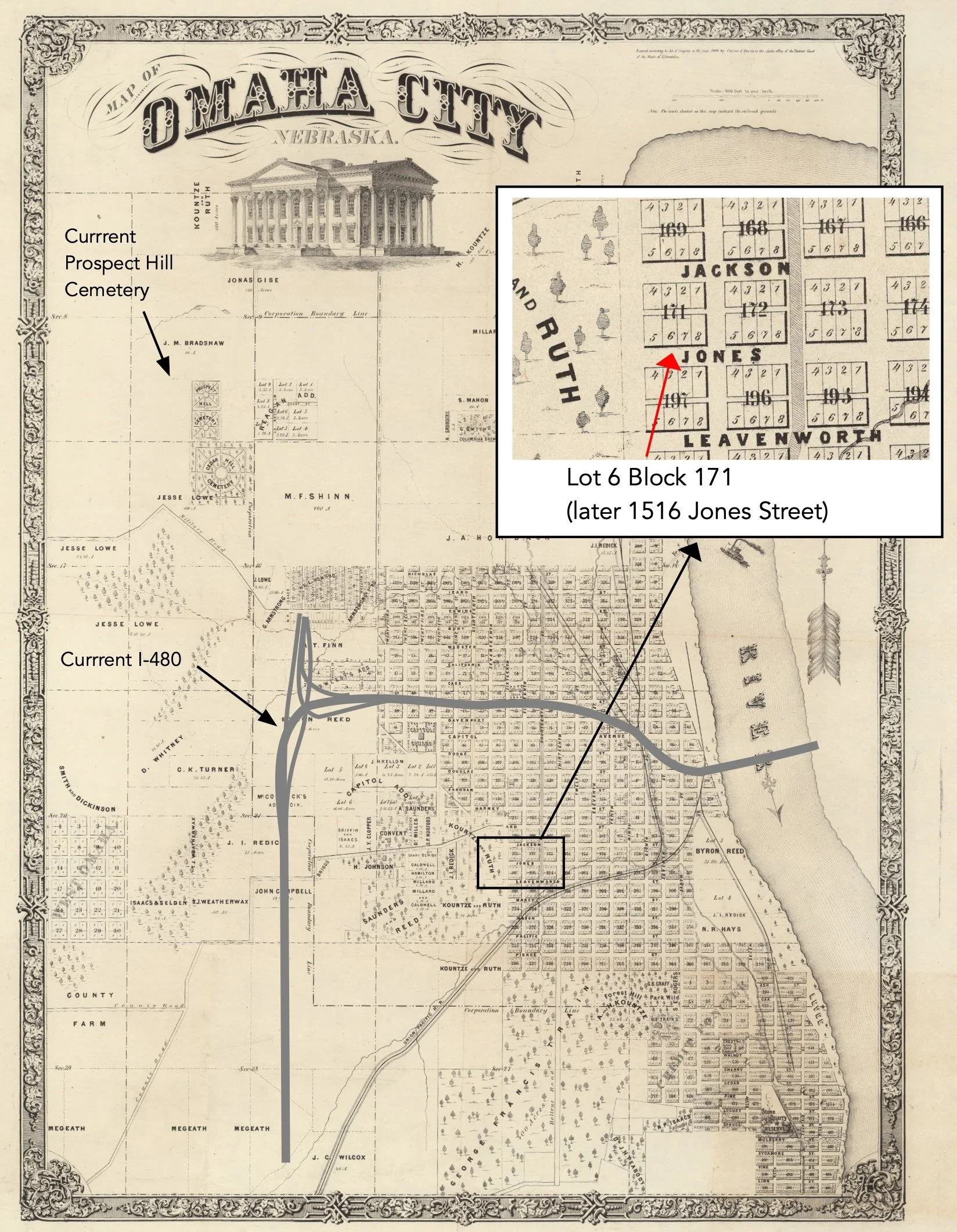
Our new home was just a patch of prairie grass for the first 11 years of its legal identity, as were most of the lots in the early days of Omaha. There were 10 owners of Lot 6, Block 171 during those 11 years as the property was bought and sold during a period of land speculation. From 1858 to 1862, Lot 6 Block 171 was owned by land investors John and Eliza Hughes, residents of Manchester, England!
The address “1516 Jones Street” was assigned in 1865 when Andrew and Amanda Orchard had a house built on the property for their new home. The Orchard family, including 10 children at the time, was a classic pioneer family, traveling west from Indiana to Omaha in 1862 in two covered wagons. They originally lived in a tent close the Missouri River near the ferry landing from Council Bluffs. There were no bridges at the time. Eventually they saved enough money to buy the property and then hire a builder to construct their home. With 10 children, the Orchard family was the original “crowded table” of 1516 Jones. One of the Orchard children co-founded a very successful furniture store located at 16th and Harney Streets. “Orchard and Wilhelm” was in business from 1893 until 1971. The site was redeveloped and is now the headquarters building for OPPD. Andrew Orchard died in 1880. Amanda remained in the house for about a year before moving about one block away with the youngest children still living at home. She sold the property to Ferdinand Streitz in late 1880.
“Ferd” Streitz immigrated to America from Germany in 1851 and can first be placed in Omaha in 1863. Streitz was a carpenter and is believed to have built the home at 1516 Jones for the Orchard family. The Streitz family lived near 11th and Capital Streets. Over a period of years, Ferd bought several homes in central Omaha, turning them into rental properties as he did with the house on Jones Street. The first renters were Clive and Christine Anderson and their two children, plus five “roomers”, all being immigrants from Sweden. It was in this period, the 1880s, that most of the homes located on the block bounded by Jones, Jackson, 15th and 16th streets were occupied by immigrants including from Ireland, Canada, Italy and Hungary in addition to those from Sweden.
Ferd and Fredericka Streitz had four sons. One, named Emil, fancied himself as an amateur chemist and entrepreneur. He invented a concoction which he believed when injected in a few coyotes, would make them contagious with a deadly disease and cause the death of a large population of the animals. He approached the State of Wyoming to sell his serum as a method to help ranchers in the state save their livestock from losses to predator coyotes. To help sell the idea, he conveyed how he injected the chemical into his pet dog and cat, which, thankfully, did not live long enough to infect the neighbor’s pets! Wyoming would have nothing of Emil’s crazy idea and sent him packing. Emil never married and died a pauper.
Like so often with landlords in the urban core, Ferd let the property deteriorate due to lack of maintenance. 1516 Jones (the main home plus the converted wagon shed to the rear) transitioned from a single-family rental into a boarding house situation, with individual rooms rented to unrelated persons who could not afford better housing. Starting in about 1890, most of the residents were African American, typically paid little for the hard work they did. One of those residents (in the converted wagon shed), named Lizzie King, worked as a maid for the Abraham Reed family (as documented in the 1900 census). Abe was president of the Byron Reed real estate company, a firm founded by his father in the early days of the city. The Reeds were one of the wealthiest families in Omaha at the time. The Byron Reed company operated under that name until 2021 at which time it became part of Century Real Estate. Another resident at 1516 Jones (at the main house) in the early 1900s was Charles Austin. He was identified as a “colored porter at Burcham’s saloon” in a World Herald article reporting that he got in “a row” with Jake Williams, who suffered a fractured leg and died two days later in the hospital. The death was ruled an accident. Many of the African Americans who lived at 1516 Jones were born into slavery in southern states, moving north for opportunity in the years following the Civil War.
In 1910 Ferd Streitz sold 1516 Jones to Harry Brown, who kept the property as a low-cost rental. Then, in 1916, the property was sold to Carl and Emma Anderson for $15,000. Accounting for inflation, that is equivalent to $458,284 in 2026 dollars. It is possible the Andersons continued to rent out the home for a few years, but being landlords was not their long-term plan. More about that in Part 2.
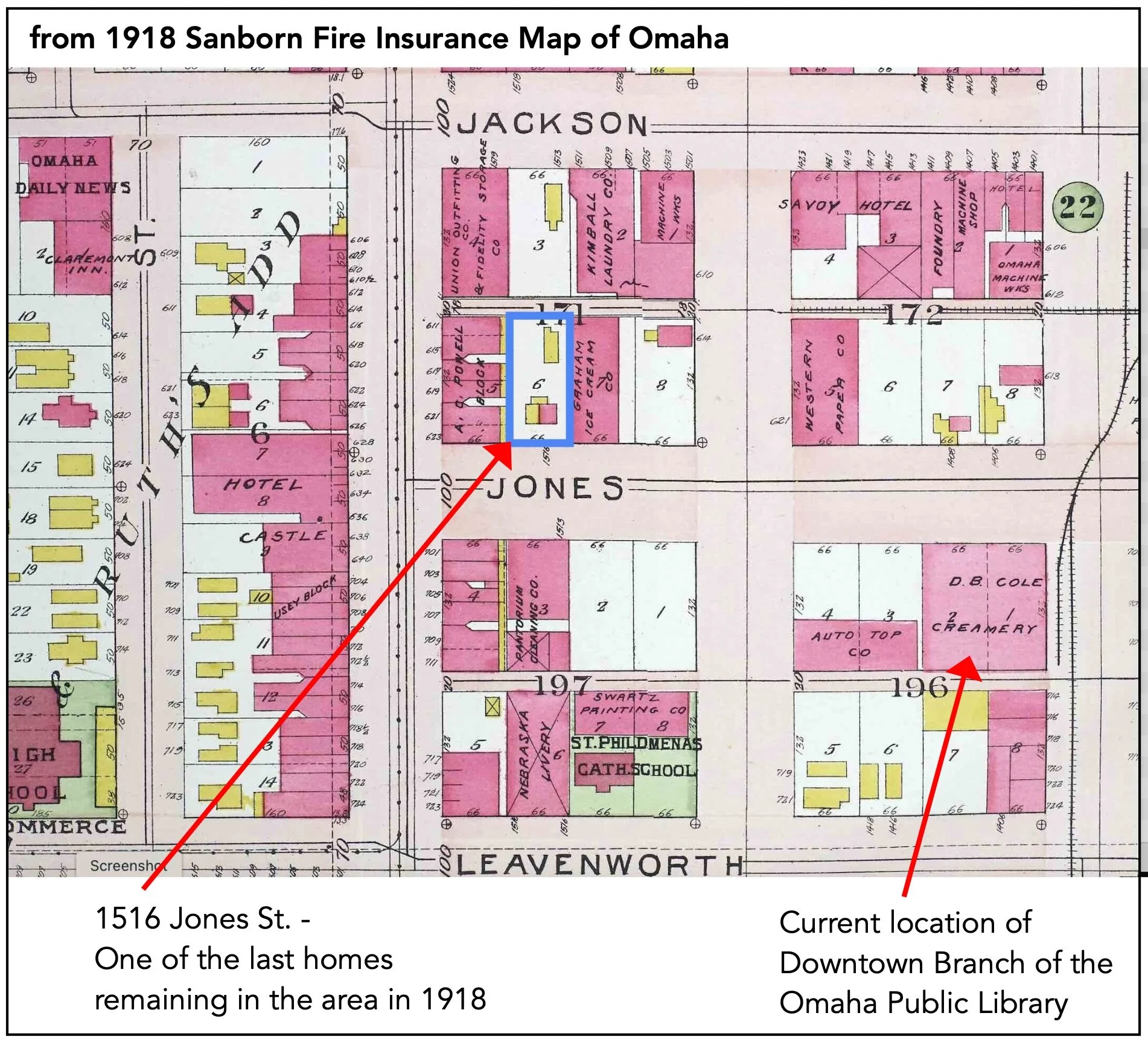
This 1918 map shows the block bounded by Jones, Jackson, 15th and 16th streets as being well into the transition from residential to urban land use.
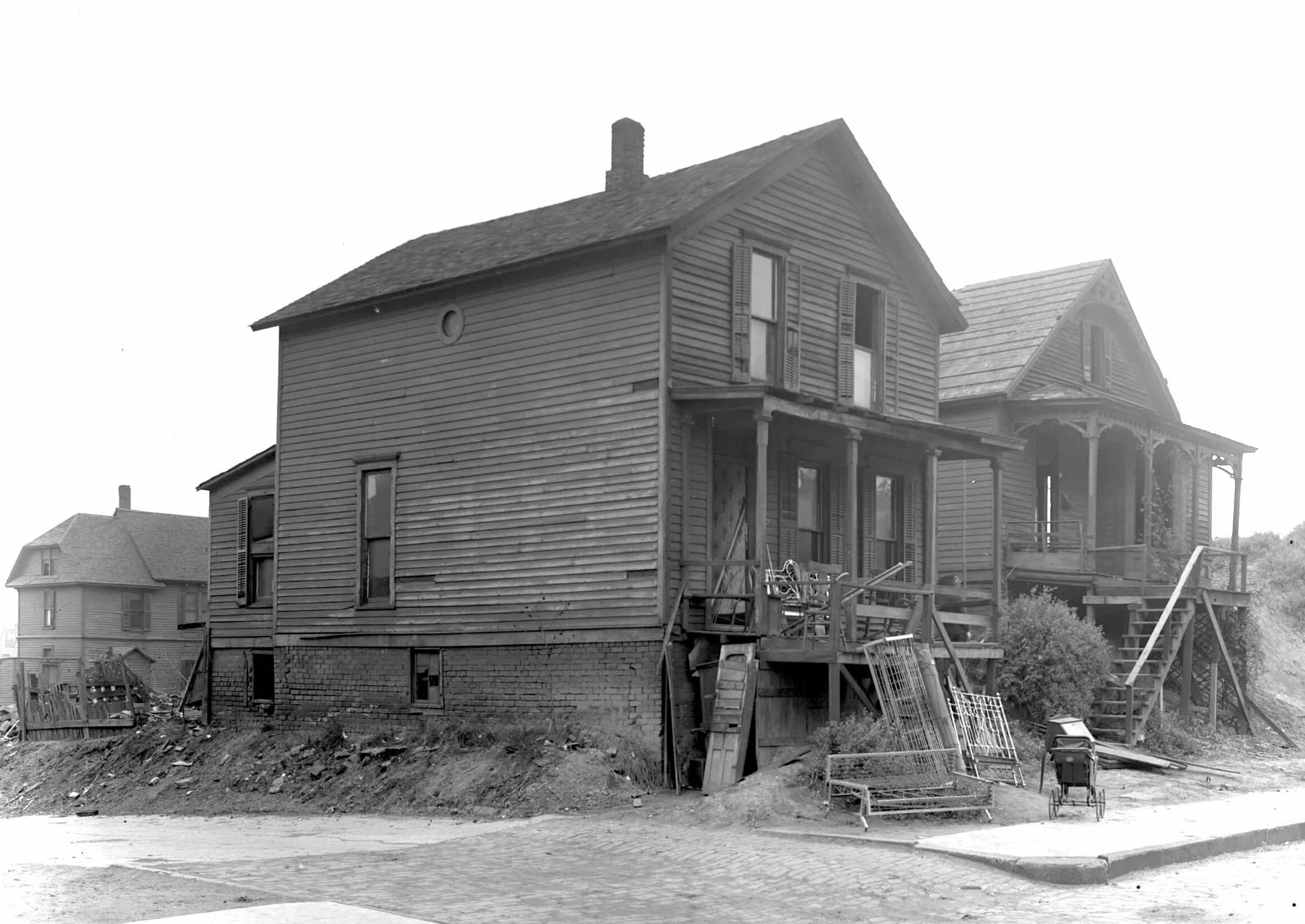
In 1916, when purchased by the Andersons, the house was 51 years old and believed to be in disrepair, suffering from a lack of attention during the period it served as a boarding house and from the quality of materials used in the original wood frame construction in 1865. The house at 1516 Jones Street is believed to have looked very similar to these homes, photographed in 1912, located at 15th and Jones.
1516 History Summary Part 2: The Commercial Business Phase
Carl and Emma Anderson purchased 1516 Jones Street in 1916 whereupon they began designing a building to house Carl’s automotive repair business on the property. They continued to rent the structure as a residence for about three years. Carl was familiar with the neighborhood, having grown up living in a home near the intersection of 16th and Leavenworth, just one block to the south. When they purchased 1516 Jones, Carl and Emma lived in south Omaha, near 19th and Deer Park Boulevard.
Carl served in the Spanish-Amercian war as a machinist with the U. S. Navy. After discharge, he returned to Omaha and took jobs as a chauffeur, working for families that could afford to own an automobile but did not have the ability to drive one of the new-fangled machines. Chauffeurs at the time probably spent as much time repairing the machines as they did driving the owners about town. By 1914, Carl started his own business, repairing automobiles as well as buying and selling used cars.
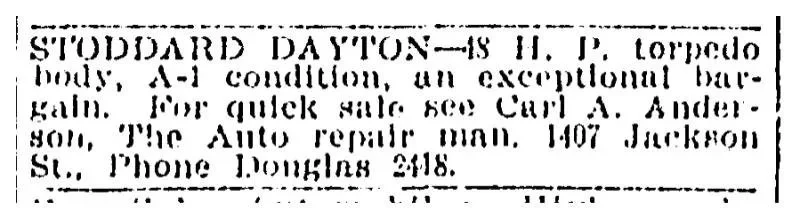
Here is the first advertisement placed in the Omaha World Herald by “The Auto Repair Man”. This was in the June 14, 1914, edition of the paper.
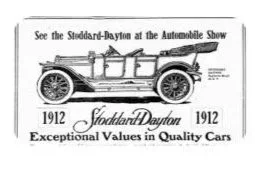
Carl’s repair shop was in a small building on the alley near 14th and Jackson streets. His business was so successful, he quickly outgrew the rental building and decided to purchase the last remaining house on the block bounded by Jones, Jackson, 15th and 16th streets to be the home for his automotive business. At that time, other business on the block included the Kimball Laundry, the Graham Ice Cream Company and Union Outfitting. Across the street from 1516 Jones was the Pantorium Cleaning Company, and at the end of the block was the Hotel Castle. Hmmmm – outgrow a rental space and buy the property at 1516 Jones to expand. Sound like anyone we know?
In 1919, Carl and Emma had the house demolished and began construction of the brick and cement block building that exists today and is the new home for Urban Abbey. Also at this time, they formed the corporation, Carl A. Anderson, Inc., which became the legal owner of 1516 Jones Street. Here is a photo of the building taken in 1920 when the automotive business first occupied that address.
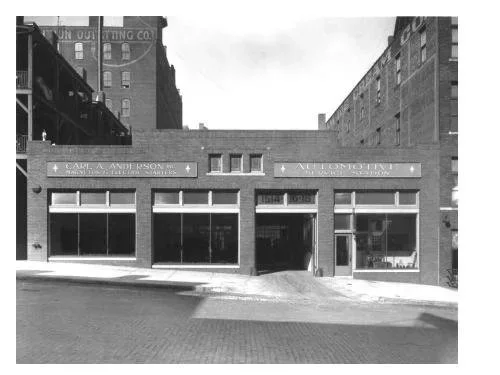
As the auto repair activity continued to grow, Carl A. Anderson, Inc. got into the auto parts distribution business, at first just locally but eventually regionally. As the firm grew rapidly in the 1930s and 1940s, Carl bought the Powel Block building around the corner, facing west on 16th Street. This was used for corporate offices and for added parts inventory storage space. The company began referring to its location as simply “16th and Jones.”
No advertisements to promote the business could be found, indicating Carl A. Anderson was well known in the automotive repair industry as a distributor of parts and among the public as a repair shop. The only ads to be found in the newspaper were frequent want ads for personnel, and the annual Christmas greeting, and placement in support of the WWII effort.
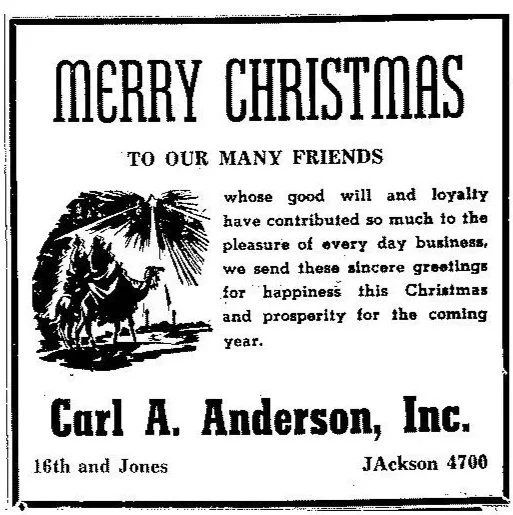
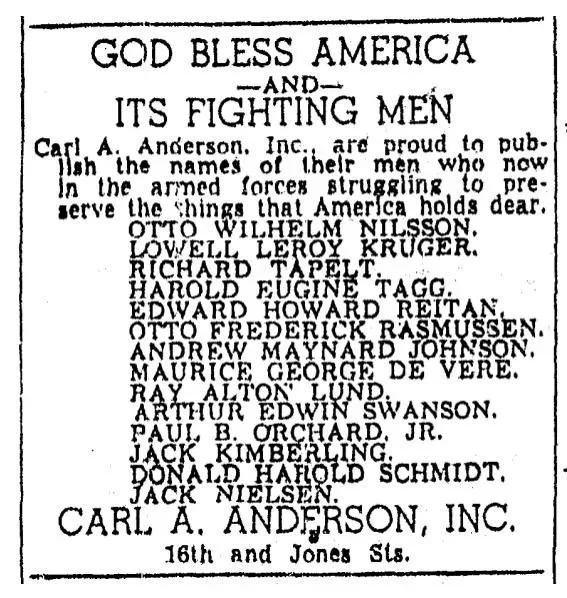
At its peak, Carl A. Anderson, Inc. had more than 200 employees with distribution centers, branches, service centers and a dealer network stretching across the middle of the United States from Texas to Minnesota. When Carl retired from the business, the company was run by his nephew on his first wife’s side of the family. Twenty years following Carl’s death in 1954, the company had outgrown its location at 16th and Jones and moved to a much larger facility at 144th and Grover Streets.
Carl A. Anderson, Inc. operated at 1516 Jones Street from 1920 to 1976. That 56-year period makes Carl Anderson, the man and the company, the longest owner of the property by a long shot.
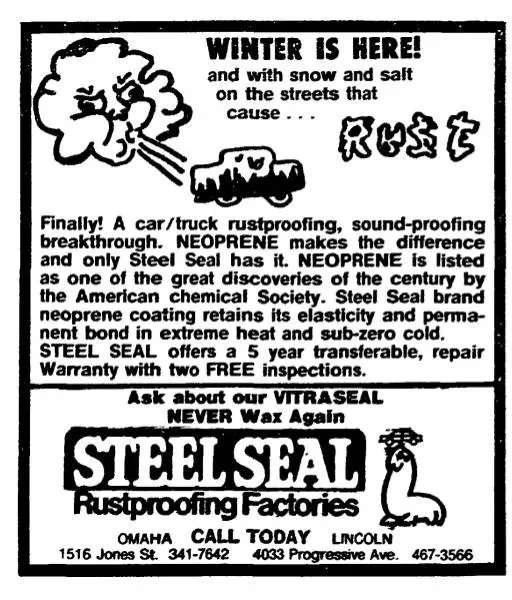
The new owner of 1516 Jones was Joseph J. Tourek, who promoted the building for warehouse or light industrial usage. Fore three years starting in 1976, Urban Abbey’s new home was used by the Steel Seal Company as a facility to rustproof cars and boats. That company moved to 132nd and “I” Streets in 1979.
The next commercial business to operate at 1516 Jones Street was the Buffalo Printing Company. This was an off-shoot of the American Indian Center which had their offices next door in the building at the corner of 16th and Jones Streets. It was hoped the printing business would help fund the non-profit Indian Center organization, but Buffalo Printing was not successful, and the American Indian Center declared bankruptcy in 1990.
Joseph Tourek then advertised the building again as a warehouse space but was unsuccessful in getting any takers. This led to the purchase of the property by Joseph J. Cascio and the transition of the property to a nightclub and entertainment venue. This will be summarized in a special edition of this history summary in October. Part 3 of this history series will feature Carl A. Anderson, one of the most successful business, charitable, and civic-minded persons in Omaha during his time.